

If you’re searching for a clear edge in today’s fast-moving esports landscape, you’re in the right place. Winning isn’t just about quick reflexes anymore—it’s about mastering competitive gaming strategy at every level, from mechanical skill to team coordination and meta awareness. This article breaks down what actually separates top-tier players from the rest: smarter decision-making, optimized settings, efficient practice routines, and a deep understanding of evolving multiplayer dynamics.
We’ve analyzed current tournament play, studied patch impacts across major titles, and reviewed insights from high-ranking players to ensure the guidance here reflects what’s working right now—not outdated tactics. Whether you’re climbing ranked ladders or preparing for organized competition, you’ll find actionable strategies designed to sharpen performance and give you a measurable advantage. Let’s dive into the tactics, tools, and mindset shifts that turn consistent players into consistent winners.
Beyond Raw Skill: The Mindset of a Champion
To truly grasp the nuances of a core digital strategy in competitive gaming, it’s essential to explore how these strategies intersect with diverse playstyles, such as those outlined in our recent article on comparing offensive and defensive approaches in online games – for more details, check out our Comparing Offensive and Defensive Playstyles in Online Games.
Talent gets you noticed; mindset makes you feared.
“I used to grind eight hours a day,” one ranked player told me. “Then my coach said, ‘Stop playing. Start thinking.’”
That shift defines competitive gaming strategy at its highest level.
Framework beats frenzy.
Plateaus happen when practice lacks reflection. After every loss, ask, “What decision lost the round?” Elite players run mini post-mortems (yes, like detectives in a crime drama).
Some argue mechanics trump mindset. But as one analyst bluntly put it, “Skill caps. Awareness doesn’t.”
Pro tip: track patterns, not just stats.
Deconstructing the Meta: How to Analyze and Adapt
Understanding the Metagame
The meta (Most Effective Tactic Available) is the current best-performing way to play. It forms when players discover optimized builds, team comps, or tactics that consistently win. But it never stays still. Balance patches tweak numbers, new characters release, and creative players break old assumptions (because someone always finds the loophole). According to developer patch notes across major esports titles, even minor percentage buffs can significantly shift win rates over time. That’s why yesterday’s powerhouse pick becomes today’s benchwarmer.
Active Analysis vs. Passive Following
Copying a top player’s build is easy. Understanding why it works is powerful.
Passive following says: “This won a tournament. I’ll use it.”
Active analysis asks:
- What problem does this build solve?
- Is it strong because of synergy, map design, or current patch values?
- Does it fit my playstyle?
Think of it like competitive gaming strategy in chess versus memorizing openings without understanding positioning. One adapts. The other collapses under pressure.
Practical Steps for Meta Analysis
Use this checklist:
- Read patch notes fully (not just highlights).
- Watch pro VODs and pause to ask why decisions were made.
- Track win-rate data on reputable stat sites.
- Test changes in controlled matches before ranked play.
Pro tip: Focus on trends across multiple high-level matches, not one viral clip.
Counter-Meta Strategy
If everyone runs the same strategy, it creates predictability. Identify its weakness—limited mobility, resource reliance, slow scaling—and build specifically to exploit it. The goal isn’t rebellion. It’s leverage. (And yes, upsetting a dominant meta feels a little like landing the final boss hit.)
The Art of Practice: Drills, VOD Review, and Deliberate Improvement
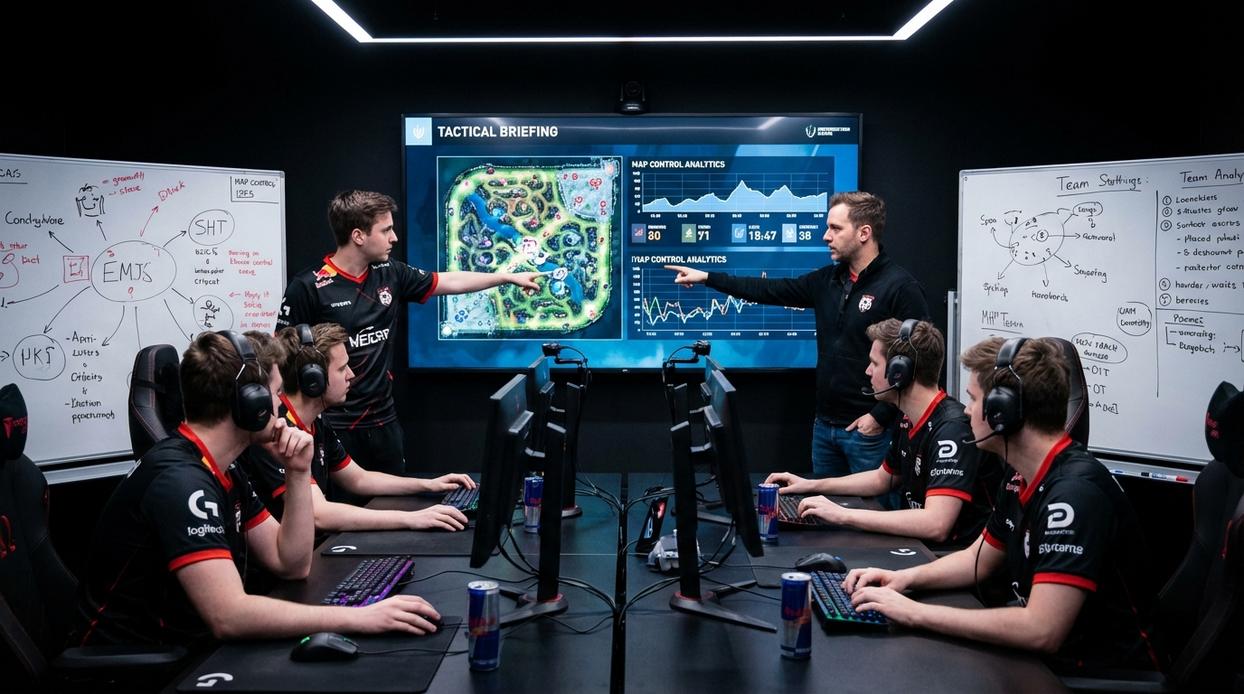
Why “Just Playing” Isn’t Enough
Let’s get this out of the way: grinding ranked for six hours straight is not a training plan. It’s a vibe. And vibes don’t fix bad habits.
Deliberate practice means practicing with a specific goal in mind, not just playing to win. Psychologist Anders Ericsson, who popularized the concept, found that improvement comes from focused, feedback-driven effort—not repetition alone (Ericsson et al., 1993). In gaming terms, that means queuing up with intention. For example, instead of saying, “I’ll win more fights,” say, “I’ll improve my crosshair placement in close-range duels.”
Sure, some players argue that “real improvement only happens in live matches.” There’s truth there—pressure matters. But without focused correction, you’re just reinforcing mistakes (like rehearsing the wrong dance move and wondering why you still look awkward).
Implementing VOD Review
VOD review (Video on Demand review) is simply rewatching your gameplay footage to analyze decisions. It’s less glamorous than playing, but wildly effective.
Here’s a step-by-step approach:
- Watch once without pausing to spot obvious mistakes.
- Rewatch key moments and pause before major decisions. Ask: What was I thinking?
- Look for:
- Positioning errors (Were you overexposed?)
- Missed opportunities (Did you ignore a free objective?)
- Decision-making flaws (Did you panic-ult?)
- Take short, actionable notes.
Interestingly, this mirrors how data teams refine competitive gaming strategy at elite levels—identify patterns, isolate variables, adjust. For deeper insight, explore how data analytics shapes modern game planning.
Targeted Drills and Scenarios
Once you identify a weakness, isolate it. Struggling with aim? Run 15-minute aim trainer routines daily. Dropping combos? Practice them 50 times in training mode. Communication sloppy? Run mock scenarios with your team focused only on callouts.
Creating a Feedback Loop
Now connect it all. VOD reveals missed flank checks. You design a map-awareness drill. After a week, review new footage. Improvement? Great. Still shaky? Adjust.
That cycle—review, drill, apply—is your growth engine. It’s not flashy. But neither is leveling up. (Okay, maybe a little flashy.)
Mastering the Mental Game: Composure, Communication, and Team Synergy
Winning the Internal Battle
Tilt—an emotional state where frustration overrides decision-making—destroys more matches than bad mechanics ever will. Ranked anxiety (the fear of losing status or points) does the same, just more quietly. Studies on performance psychology show stress impairs working memory and reaction time (American Psychological Association). That means your anger literally makes you slower.
Here’s what I recommend:
- Use a reset ritual: after a bad play, take one deep breath, unclench your jaw, and rest your hands for five seconds.
- Name the mistake objectively: “I overextended,” not “I’m trash.”
- Refocus on the next objective, not the last error.
Think of it like pressing a mental respawn button.
The Science of Effective Communication
Great comms follow the 3 C’s: Clear, Concise, Calm.
Bad: “They’re everywhere! I can’t—just help!”
Good: “Two pushing left corridor, one low health.”
Notice the difference? Specific, brief, steady. Neuroscience research shows calm vocal tones reduce team stress responses (Frontiers in Psychology). So even if chaos erupts, sound steady anyway (yes, fake it if you must).
Building Team Synergy
If you’re serious about improvement, formalize your structure:
- Define roles clearly.
- Assign a shot-caller.
- Run short post-game debriefs: What worked? What failed? What changes next?
Trust builds through predictability. That’s the backbone of competitive gaming strategy.
Adaptability Under Pressure
When opponents adjust, you must too. Instead of “We’re getting rolled,” ask, “What pattern are they exploiting?” Shift positioning. Change tempo. Swap roles if needed.
Recommendation: treat every setback as data. Teams that problem-solve mid-match win more—period.
You now have a complete framework for improvement. Breaking a plateau demands structure, not grind. Here’s how to apply it this week:
- VOD review: Record one match, rewatch it, and pause at every death. Ask, “What information did I ignore?”
- Meta-analysis: Read the latest patch notes and list two changes that affect your role.
- Communication drills: In your next queue, call out timers and enemy positions every minute.
This practical competitive gaming strategy turns you from a passive player into an active student. Pro tip: track one metric—KDA, objective control, or damage per round—and measure it for five sessions. Start today.
Level Up Your Edge
You came here to sharpen your understanding of emerging game trends, multiplayer evolution, and smarter optimization tactics—and now you have the roadmap to do it.
The reality is that falling behind in today’s fast-moving gaming landscape happens quickly. New metas form overnight. Updates shift balance. Players who don’t adapt get outplayed. That frustration of knowing you could perform better—but not knowing exactly how—is what holds most competitors back.
By applying these insights and refining your competitive gaming strategy, you position yourself ahead of the curve instead of scrambling to catch up. Awareness turns into preparation. Preparation turns into wins.
Now it’s your move: stay locked in to the latest game shifts, apply these optimization tactics consistently, and put your knowledge into action in your next session. Players who actively adapt outperform those who passively play.
If you’re serious about climbing ranks, mastering evolving metas, and gaining a real competitive edge, keep following our expert breakdowns and strategy rundowns trusted by dedicated players. Don’t just play—optimize, adapt, and dominate.
 There is a specific skill involved in explaining something clearly — one that is completely separate from actually knowing the subject. Thalira Vosswyn has both. They has spent years working with expert breakdowns in a hands-on capacity, and an equal amount of time figuring out how to translate that experience into writing that people with different backgrounds can actually absorb and use.
Thalira tends to approach complex subjects — Expert Breakdowns, Gameplay Optimization Tips, Civiliden Gaming Mechanics Explained being good examples — by starting with what the reader already knows, then building outward from there rather than dropping them in the deep end. It sounds like a small thing. In practice it makes a significant difference in whether someone finishes the article or abandons it halfway through. They is also good at knowing when to stop — a surprisingly underrated skill. Some writers bury useful information under so many caveats and qualifications that the point disappears. Thalira knows where the point is and gets there without too many detours.
The practical effect of all this is that people who read Thalira's work tend to come away actually capable of doing something with it. Not just vaguely informed — actually capable. For a writer working in expert breakdowns, that is probably the best possible outcome, and it's the standard Thalira holds they's own work to.
There is a specific skill involved in explaining something clearly — one that is completely separate from actually knowing the subject. Thalira Vosswyn has both. They has spent years working with expert breakdowns in a hands-on capacity, and an equal amount of time figuring out how to translate that experience into writing that people with different backgrounds can actually absorb and use.
Thalira tends to approach complex subjects — Expert Breakdowns, Gameplay Optimization Tips, Civiliden Gaming Mechanics Explained being good examples — by starting with what the reader already knows, then building outward from there rather than dropping them in the deep end. It sounds like a small thing. In practice it makes a significant difference in whether someone finishes the article or abandons it halfway through. They is also good at knowing when to stop — a surprisingly underrated skill. Some writers bury useful information under so many caveats and qualifications that the point disappears. Thalira knows where the point is and gets there without too many detours.
The practical effect of all this is that people who read Thalira's work tend to come away actually capable of doing something with it. Not just vaguely informed — actually capable. For a writer working in expert breakdowns, that is probably the best possible outcome, and it's the standard Thalira holds they's own work to.